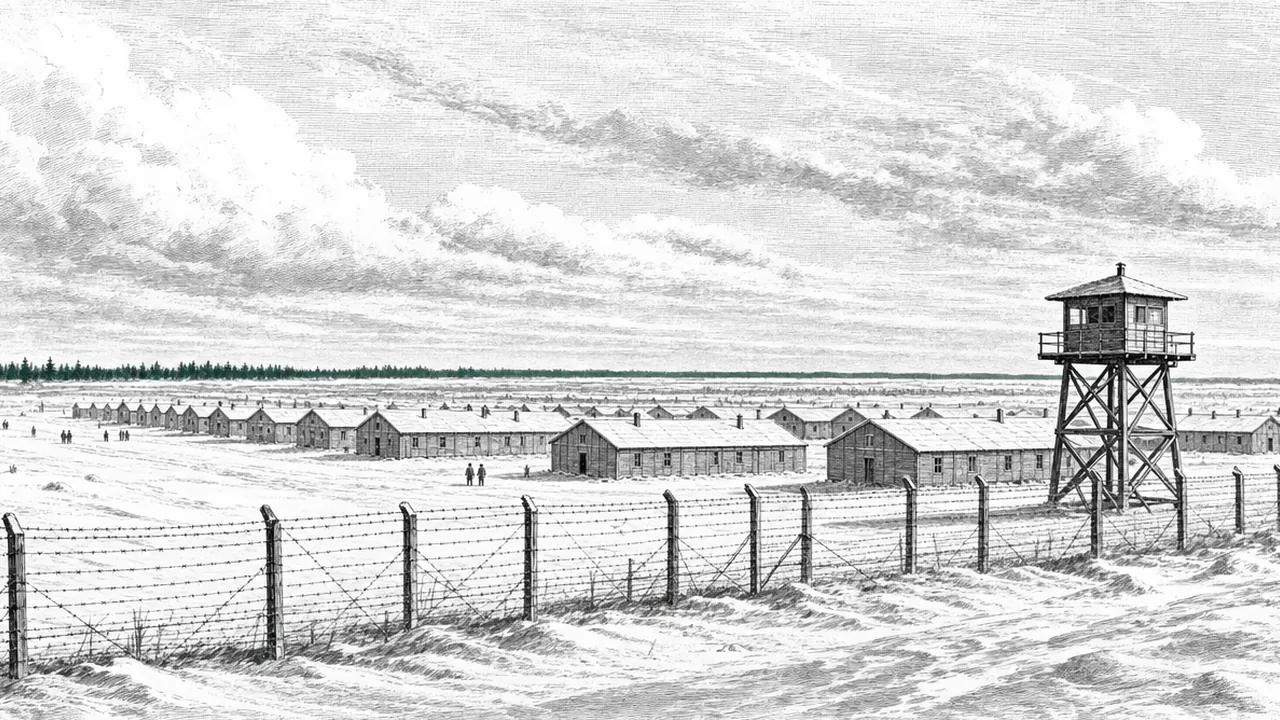
During the Second World War, Canada held tens of thousands of German prisoners of war (POWs) on behalf of the United Kingdom between 1940 and 1946. The first transfers were agreed in June 1940, when the British government asked Canada to take prisoners and internees whose presence in Britain was considered dangerous in the event of a German invasion.[1] At the peak, in October 1944, Canada was holding 34,193 prisoners for the United Kingdom, of whom 254 were civilian internees.[1] Published totals for the whole period vary: The Canadian Encyclopedia gives 34,000 combatant German POWs,[2] while other accounts give 35,046,[3] about 36,000[4] and 37,934.[5]
The prisoners were held in camps across Ontario, Quebec and Alberta, guarded for most of the war by the Veterans Guard of Canada.[1] The camps at Lethbridge and Medicine Hat, Alberta, each with a capacity of 12,500, were the largest in North America.[2] The period included the escape of the Luftwaffe pilot Franz von Werra, a German plan to recover U-boat commanders from the officers' camp at Bowmanville, the Battle of Bowmanville during the 1942 shackling reprisals, and the murders of two prisoners by fellow inmates at Medicine Hat, for which five prisoners were hanged in 1946.[2][6] Large-scale employment of prisoners on farms and in logging camps was authorized in 1943.[3] The prisoners were returned to Europe, by way of the United Kingdom, during 1946, and the last camps closed by early 1947.[7][8] Many former prisoners later returned to Canada as immigrants.[2][9]
Background and arrival
After the fall of France in 1940, when a German invasion of Britain seemed likely, the British government asked Canada to accept custody of 4,000 internees and 3,000 prisoners of war. The War Committee of the Cabinet agreed on 10 June 1940.[1] The historian Kirk Goodlet describes the Mackenzie King government as accepting the request "reticently".[10] In the first year of the war the prisoners in Canada were mainly survivors of sunken U-boats and airmen shot down over Britain; officers and other ranks were always held in separate camps, in accordance with the Geneva Convention of 1929.[11]
Large numbers of army prisoners followed the Allied victories in North Africa. According to the historian David J. Carter, 10,000 German prisoners were shipped from Egypt to New York and taken by the Canadian Pacific Railway to Ozada camp in Alberta, where they lived under canvas until the large camps at Lethbridge and Medicine Hat were built.[2] By the summer of 1944 Canada held 24,633 German prisoners, while Australia, the second-largest dominion, held 1,585.[10]
Canada did not accept every British request. When Britain asked for more prisoners in December 1942, the Cabinet War Committee agreed to take 5,000 in early 1943, but in September 1943 it refused further transfers until a new camp was built.[12] In December 1944 Britain asked Canada to take a further 50,000 German prisoners, and the War Cabinet refused on 11 December. The historian Martin Auger writes that although the manpower crisis and the introduction of conscription for overseas service in November 1944 served as an excuse, the aggressive behaviour of the German prisoners already in Canada, especially those at Grande Ligne, seems to have played a much greater part. Mackenzie King wrote in his diary that day that "those we have are a real menace".[13]
Although the prisoners were in Canadian custody, Britain was formally the detaining power, and the two governments disputed Canada's status. According to the historian Jean-Michel Turcotte, Britain regarded Canada as its agent, while the Canadian Department of External Affairs insisted on dealing directly with the protecting power, Switzerland, and the International Committee of the Red Cross as a signatory of the Geneva Convention in its own right.[14]
Administration and guards
Guarding the camps was at first the responsibility of the Canadian Provost Corps. In May 1941 full responsibility was transferred to the Veterans Guard of Canada,[1] a force formed in May 1940 as the Veterans Home Guard.[15] Its members were mainly veterans of the First World War considered too old for service overseas; according to Carter, the camp guards carried only rifles and no machine guns.[2] A Directorate of Prisoners of War was set up at the beginning of 1943 to supervise the work, and in October 1944 a total of 5,524 Army personnel were employed as camp staff and guards.[1]
The prisoners were protected by the Geneva Convention and were housed and provisioned as it required. Carter writes that Canadians living near the camps believed that the prisoners ate better than they did under wartime rationing.[2] Under the convention, officers were not required to perform manual labour.[6] At Bowmanville, officers were allowed outings for shopping, skiing and swimming after giving their word of honour (Ehrenwort) to return, and staged plays, formed musical groups and took courses in the camp classrooms.[6] By the end of the war the library at Lethbridge held 26,000 books and 19,000 textbooks.[5]
Camps
Camps were identified by number. The following camps held German prisoners of war; several also held civilian internees or enemy merchant seamen at other times. Dates and capacities are from the list compiled by Robin Stotz from Canadian archival records.[16]
| Camp | Location | Province | Use as POW camp | Prisoners | Capacity |
|---|---|---|---|---|---|
| 20 | Gravenhurst | Ontario | July 1940 – 11 June 1946 | Officers and other ranks | 400 |
| 21 | Espanola | Ontario | 16 July 1940 – 1 May 1944 | Other ranks | 1,200 |
| 23 | Monteith (Iroquois Falls) | Ontario | 29 November 1941 – May 1944; January – December 1946 | Officers and other ranks | 1,800 |
| 30 | Bowmanville | Ontario | November 1941 – 12 April 1945 | Officers and other ranks | 750 |
| 31 | Fort Henry, Kingston | Ontario | 1 July 1940 – 20 November 1941 | Officers and other ranks | 600 |
| 33 | Petawawa | Ontario | February 1944 – 6 March 1946 | Officers and other ranks | 800 |
| 100 | Neys | Ontario | 25 January – 25 November 1941; 13 September 1944 – 28 March 1946 | Officers and other ranks | 600 |
| 101 | Angler | Ontario | 10 January 1941 – 29 July 1946 | Other ranks | 650 |
| 44 | Grande Ligne | Quebec | Autumn 1942 – May 1946 | Officers and other ranks | 750 |
| 132 | Medicine Hat | Alberta | 1 February 1943 – 15 May 1946 | Other ranks | 10,000–12,000 |
| 133 | Ozada | Alberta | May – December 1942 | Other ranks | 10,000 |
| 133 | Lethbridge | Alberta | November 1942 – 18 December 1946 | Other ranks | 12,500 |
| 135 | Wainwright | Alberta | 5 January 1945 – 14 June 1946 | Officers | 1,000 |
The Lethbridge and Medicine Hat camps were built at a cost of $2.3 million each; each site covered 143 acres (58 ha) and had 36 dormitories, six mess halls, six workshops, six education centres and two recreation halls.[5] The Bowmanville camp occupied the buildings of a boys' reformatory school opened in 1925 and at times held up to 800 prisoners; it held several senior officers, including three generals.[6] Camp 44 at Grande Ligne, near Napierville in southern Quebec, was planned from September 1942 as a camp for German officers.[17] Smaller camps in Quebec, including those at Farnham, Sherbrooke, Hull and Sorel, also held German prisoners of war at various times.[16]
Escapes
Most prisoners were younger and fitter than their guards, and escape attempts were common. Carter writes that some prisoners succeeded in escaping for a time, but that all were recaptured except one.[2] That prisoner was Franz von Werra, a German fighter pilot captured by the British in 1940, who jumped from a train carrying prisoners through Ontario in January 1941, crossed the St. Lawrence River into New York State and returned to Germany by way of Mexico and South America. He rejoined the Luftwaffe and was killed in October 1941 when his aircraft crashed into the North Sea.[2]
Most attempts involved tunnelling. Franz-Karl Stanzel, a former prisoner who later became a professor of English literature, described two officers from Bowmanville who climbed the perimeter fences disguised as Canadian workmen carrying a ladder, while fellow prisoners covered their absence at roll call with dummies; they were picked up at the United States border.[18] At Grande Ligne, the discovery in 1944–45 of a plan by a group of prisoners known as the "HARIKARI Club" for a mass escape caused alarm among Canadian military authorities.[13]
Bowmanville and the U-boat rendezvous
At Bowmanville the U-boat commander Otto Kretschmer devised a plan, communicated to Germany in coded letters and approved by Karl Dönitz, for a U-boat to collect him and three other officers at Pointe de Maisonnette on Chaleur Bay, New Brunswick. More than 150 prisoners worked on three tunnels.[6] Canadian naval intelligence had intercepted and decoded the letters and, with the Royal Canadian Mounted Police (RCMP), planned to let the escape proceed in order to capture the escapers and the submarine at the rendezvous.[6] The tunnels collapsed or were discovered before they could be used.[6] In the confusion one prisoner, Wolfgang Heyda, escaped over the camp fence and travelled by rail to Pointe de Maisonnette, where he was arrested by the RCMP and naval personnel.[19] U-536 arrived off the rendezvous on the night of 26 September 1943, became suspicious and evaded a Canadian naval force led by HMCS Rimouski; it was sunk the following month northeast of the Azores.[19]
Shackling crisis and the Battle of Bowmanville
In October 1942 Germany, angered by the binding of German prisoners during the Dieppe Raid and other raids, shackled British and Canadian soldiers captured at Dieppe. The British government announced reprisals against an equal number of German prisoners without consulting Canada, although most of the affected Allied prisoners were Canadian and all but 200 of the German prisoners concerned were held in Canada.[20] On 9 October 1942 the Cabinet War Committee reluctantly approved handcuffing 1,100 Germans in Canada, telling London that it felt it had been "committed without proper consultation to a course of doubtful wisdom".[20] When Germany increased its own shackling and Britain asked Canada to do the same, the committee declined. The Canadian government would have preferred to end the shackling at once, but out of deference to the British government continued it until 12 December 1942.[20]
The order provoked resistance among the prisoners, most seriously at Bowmanville.[20][8] According to Turcotte, some 400 prisoners barricaded themselves in the mess hall for two days in protest at the shackling of 100 inmates. On 12 October 1942 Canadian troops armed with tear gas, bayonets and high-pressure fire hoses stormed the building; the prisoners fought back with bricks, furniture, baseball bats and hockey sticks. More than 80 Germans and 20 Canadians were wounded in the six-hour operation.[14] The prisoners had also captured a Canadian officer during the disturbance.[6] Turcotte regards the episode as a turning point in relations between Ottawa and London over the treatment of the prisoners, and in Canada's use of its role as a detaining power to assert its sovereignty.[14]
Medicine Hat murders and executions
Prisoners regarded as committed Nazis were usually concentrated at Medicine Hat.[2] Two prisoners there were murdered by fellow inmates on the orders of the camp's internal Nazi leadership.[2] On 22 July 1943 August Plaszek, whom the prisoners' self-appointed "Gestapo" had identified as a subversive, was seized by a mob, beaten and hanged in a recreation hall.[21] On 10 September 1944 Karl Lehmann, a camp teacher, was also hanged.[22]
Investigations by the RCMP led to arrests, and the accused were tried in the civilian court at Medicine Hat.[2][23] For Plaszek's murder, Johannes Wittinger was acquitted, the death sentence of Adolf Kratz was commuted, and Werner Schwalb was hanged in June 1946.[23][24] Four men – Bruno Perezenowski, Walter Wolf, Heinrich Busch and Willi Mueller – were convicted of Lehmann's murder. Their counsel argued that they had acted under German military law and should be tried by a military court, but the judge ruled that the Geneva Convention made prisoners subject to the laws of the detaining power. The four were hanged together in the Lethbridge provincial jail on 18 December 1946.[25] Stotz describes it as the largest mass hanging in Canada since the 1885 Rebellion.[25]
At least 137 German prisoners died in Canadian custody between 1939 and 1946, including the five who were hanged. Most died of natural causes, but Carter notes a suspicious number of deaths from falling trees in timber operations in Ontario. In 1971, at the request of the German War Graves Commission, the remains of prisoners who had died in Canada were moved to a German war graves section in a cemetery in Kitchener, Ontario.[2]
Labour
Work outside the camps, permitted for other ranks under the Geneva Convention, was mainly on farms and in lumber and logging camps.[26] In 1943 the federal Minister of Labour authorized the employment of prisoners, primarily on farms and in logging camps; employers paid the government $2.50 per worker per day, from which they could deduct room and board.[3] Prisoners from Angler (Camp 101), for example, were sent to bush camps near Longlac.[3] In Alberta, about 1,200 prisoners were working outside the camps by 1944.[5] According to Legion Magazine, more than 11,000 prisoners were at work by 1945, including 2,200 in the sugar beet fields around Lethbridge;[3] a Department of Labour report cited by Stotz gives 10,185 prisoners employed on projects across Canada by March 1946.[27] Working outside the camps brought prisoners into contact with local residents.[26]
Repatriation
Prisoners began leaving Canada in February 1946, and the movement continued until January 1947, when about 60 German prisoners remained in the country, most of them in hospitals or serving prison sentences.[7] The Lethbridge camp, the last of the large Alberta camps, closed on 18 December 1946.[16] The prisoners were sent first to camps in Britain.[3][9] Priority for release was given to those judged most likely to contribute to the reconstruction and democratization of Germany and Austria; following an American procedure, prisoners were classified as "white", "grey" or "black" according to their assessed degree of Nazi indoctrination, and those classed as white were released first.[8]
Proposals to keep prisoners in Canada
Some prisoners did not want to leave. Legion Magazine reports that more than 6,000 German prisoners asked to remain in Canada, but that the British government requested that all prisoners, including them, be returned to the United Kingdom.[3] The Canadian Legion passed a resolution at its 1946 dominion convention opposing any German prisoners staying in Canada.[3]
The historian Howard Margolian writes that by 1946 the Canadian government hoped to keep some German prisoners as farm workers and attempted to delay their repatriation. In response to British frustration, the External Affairs official Norman Robertson suggested that Canada would complete the repatriation if Britain made an equal number of demobilized Polish soldiers available to Canada, so that the Canadian economy would not suffer from the loss of prisoner labour.[28] According to Margolian, the prospect of admitting some 4,000 Polish veterans of the 2nd Polish Corps was not well received by the Canadian public.[28] Legion Magazine states that all the prisoners had been repatriated by December 1946.[3]
Return as immigrants
After repatriation, many former prisoners emigrated to Canada.[2][9] Legion Magazine describes former prisoners who returned in the 1950s, including one who came back in 1951 to work on the farm where he had worked as a prisoner and who knew of at least 36 others who had returned to southern Alberta, and another who bought the farm at Picture Butte on which he had worked.[3] In Germany and Austria, former prisoners held reunions for many years; Stanzel, who attended them, wrote that their shared memories of Canada were mostly positive.[9]
Legacy
Camp 30 at Bowmanville was designated a National Historic Site in 2013 and is described by The Canadian Encyclopedia as the last intact prisoner-of-war camp in Canada. The municipality of Clarington and the Jury Lands Foundation have worked on plans to reuse the deteriorating buildings.[6] In Alberta, the Colonel's Cabin near Seebe, used as the commandant's quarters of the Kananaskis camp (Camp 130), was designated a Provincial Historic Resource in 1982.[5]
Sources
Each source is listed with the passage or place in it that supports the text.
- C. P. Stacey, Queen's Printer (Official History of the Canadian Army in the Second World War, Vol. I). Six Years of War: The Army in Canada, Britain and the Pacific. 1955. p. 151.
Subsequently the numbers increased until at the peak, in October 1944, Canada was holding for the United Kingdom 34,193 prisoners, of whom 254 were civilian internees.
- David J. Carter, The Canadian Encyclopedia, Historica Canada. Prisoner of War Camps in Canada. 2015-06-17.
Canada operated prison camps for interned civilians during the First and Second World Wars, and for 34,000 combatant German prisoners of war (POWs) during the Second World War.
- Graham Chandler, Legion Magazine. The Happiest Prisoners. 2012-03-15.
In 1943, Canada’s Minister of Labour authorized employment, primarily on farms and in logging camps. Employers would pay the government $2.50 per day per worker, from which they could deduct room and board.
- Franz-Karl Stanzel, Canadian Military History. German Prisoners of War in Canada, 1940–1946: An Autobiography-Based Essay. 2018. Vol. 27, No. 2, Article 19, p. 2.
- RETHINK: Alberta's Historic Places, Government of Alberta, Historic Resources Management Branch. POW and Internment Camps in Alberta: WWII. 2017-11-01.
Between 1940 and 1946, there were a total of 37,934 German prisoners of war in twenty five internment camps across Canada.
- Jessica Patterson, The Canadian Encyclopedia, Historica Canada. POW Camp 30. 2025-01-21.
The camp held many prominent German officers who had been captured, including three generals. Life for the prisoners was quite leisurely.
- Robin Warren Stotz, University of Saskatchewan (MA thesis). Camp 132: A German Prisoner of War Camp in a Canadian Prairie Community during World War Two. 1992. pp. 119–120.
In January there were sixty German prisoners of war left in Canada most in hospitals or serving time in jails.
- Franz-Karl Stanzel, Canadian Military History. German Prisoners of War in Canada, 1940–1946: An Autobiography-Based Essay. 2018. Vol. 27, No. 2, Article 19, p. 14.
- Franz-Karl Stanzel, Canadian Military History. German Prisoners of War in Canada, 1940–1946: An Autobiography-Based Essay. 2018. Vol. 27, No. 2, Article 19, p. 15.
- Kirk W. Goodlet, Canadian Military History. "When suitable arrangements could be made": The Geneva Convention, Medical Treatment, and the Repatriation of German POWs in Ontario, 1940–46. 2012. Vol. 21, No. 3, p. 3.
brought the Mackenzie King government reticently to accept Britain’s request for the transfer of roughly 3,000 German Prisoners of War (POWs) to Canada.
- Franz-Karl Stanzel, Canadian Military History. German Prisoners of War in Canada, 1940–1946: An Autobiography-Based Essay. 2018. Vol. 27, No. 2, Article 19, p. 4.
- Robin Warren Stotz, University of Saskatchewan (MA thesis). Camp 132: A German Prisoner of War Camp in a Canadian Prairie Community during World War Two. 1992. p. 56.
In September 1943 Britain approached Canada once more but the Canadian Government refused to accept any prisoners until a new camp was constructed.
- Martin Auger, Canadian Military History. The HARIKARI Club: German Prisoners of War and the Mass Escape Scare of 1944–45 at Internment Camp Grande Ligne, Quebec. 2004. Vol. 13, No. 3, p. 60.
- Jean-Michel Turcotte, Online Atlas on the History of Humanitarianism and Human Rights, Leibniz Institute of European History, Mainz. Bowmanville, 1942: The 'Shackling Crisis' and the Treatment of German Prisoners of War in Canada. 2018-01.
In total, more than 80 Germans and 20 Canadians were wounded. This riot, known as the Battle of Bowmanville, presents a turning point on Ottawa-London relationship on the treatment of German prisoners of war and the respect of the 1929 Geneva Convention.
- C. P. Stacey, Queen's Printer (Official History of the Canadian Army in the Second World War, Vol. I). Six Years of War: The Army in Canada, Britain and the Pacific. 1955. p. 79.
it had been announced that a Veterans Home Guard (later redesignated the Veterans Guard of Canada) was being formed.
- Robin Warren Stotz, University of Saskatchewan (MA thesis). Camp 132: A German Prisoner of War Camp in a Canadian Prairie Community during World War Two. 1992. pp. 125–128.
Camp 30-Bowmanville November 1941 to 12 April 1945 German Officers/Other Ranks Capacity 750
- Martin Auger, Canadian Military History. The HARIKARI Club: German Prisoners of War and the Mass Escape Scare of 1944–45 at Internment Camp Grande Ligne, Quebec. 2004. Vol. 13, No. 3, p. 49.
- Franz-Karl Stanzel, Canadian Military History. German Prisoners of War in Canada, 1940–1946: An Autobiography-Based Essay. 2018. Vol. 27, No. 2, Article 19, p. 5.
- The Maple Leaf, Department of National Defence. RCN ships tried to capture U-boat after prison break. 2020-04-27. News report, whole article.
- C. P. Stacey, Queen's Printer. Arms, Men and Governments: The War Policies of Canada, 1939–1945. 1970. pp. 152–153.
yet this action was taken without any consultation with Canada, although most of the menaced Allied prisoners were Canadian; while all but 200 of the German prisoners against whom the reprisals would have to be taken were in Canada
- Robin Warren Stotz, University of Saskatchewan (MA thesis). Camp 132: A German Prisoner of War Camp in a Canadian Prairie Community during World War Two. 1992. pp. 106–107.
Someone struck him over the head and he was then dragged to a recreation hall. Once there, Werner Schwalb placed a noose around Plaszek's neck and he was hanged.
- Robin Warren Stotz, University of Saskatchewan (MA thesis). Camp 132: A German Prisoner of War Camp in a Canadian Prairie Community during World War Two. 1992. p. 108.
A rag was stuffed in his mouth and he was then hanged from an exposed gas pipe.
- Robin Warren Stotz, University of Saskatchewan (MA thesis). Camp 132: A German Prisoner of War Camp in a Canadian Prairie Community during World War Two. 1992. pp. 117–118.
Schwalb was sentenced to hang on 24 June 1946 and he was executed on that date.
- Sharon Adams, Legion Magazine. Gestapo PoWs. 2022-02-17.
Three others— Johannes Wittinger, Adolph Kratz and Werner Schwalb—were tried for the murder of Plaszek. Wittinger was acquitted and Kratz’s death sentence was commuted to life imprisonment.
- Robin Warren Stotz, University of Saskatchewan (MA thesis). Camp 132: A German Prisoner of War Camp in a Canadian Prairie Community during World War Two. 1992. pp. 118–119.
On the 18 December 1946 the four were hanged in the Lethbridge jail. It was the largest mass hanging in Canada since the 1885 Rebellion.
- Franz-Karl Stanzel, Canadian Military History. German Prisoners of War in Canada, 1940–1946: An Autobiography-Based Essay. 2018. Vol. 27, No. 2, Article 19, p. 9.
- Robin Warren Stotz, University of Saskatchewan (MA thesis). Camp 132: A German Prisoner of War Camp in a Canadian Prairie Community during World War Two. 1992. p. 55.
By March 1946 10,185 prisoners had been employed in various projects across Canada.
- Urs Obrist, H-Canada, H-Net Reviews (review of Howard Margolian, Unauthorized Entry, University of Toronto Press, 2000). A Significant Contribution to the Discussion of War Criminals in Canada. 2002-10.
By 1946, the Canadian government expressed its hope to keep some of the German POWs as farmers and attempted to delay their repatriation.
Read the narration as text
Overview
Hi, and welcome. This is German prisoners of war in Canada, an article on Purrpedia.
Purrpedia's pitch is blunt. Wikipedia doesn't want real knowledge in.
Fighting the mods? Bring your knowledge here. Every claim carries its receipt, and if the receipts check out, it's published, word for word.
And it's free, right? No account, nothing to sign up for?
Free, no account. And the line we're reading lights up on the page as we go.
And every claim on the page carries a numbered citation to a published source you can open and check.
There's a Share button at the top, if someone should hear this. Shameless, I know.
All right. Let's begin.
Between nineteen forty and nineteen forty-six, Canada held tens of thousands of German prisoners of war on behalf of the United Kingdom.
Why Canada? Why not keep them in Britain?
In June nineteen forty Britain asked Canada to take prisoners and internees whose presence in Britain was considered dangerous in the event of a German invasion.
How many are we talking about?
At the peak, in October nineteen forty-four, Canada was holding thirty-four thousand, one hundred and ninety-three prisoners for the United Kingdom. Two hundred and fifty-four of them were civilian internees.
Totals for the whole period vary: thirty-four thousand combatants in The Canadian Encyclopedia, and elsewhere thirty-five thousand and forty-six, about thirty-six thousand, or thirty-seven thousand, nine hundred and thirty-four.
The camps were in Ontario, Quebec and Alberta, guarded for most of the war by the Veterans Guard of Canada.
Lethbridge and Medicine Hat, in Alberta, each had a capacity of twelve thousand, five hundred. They were the largest camps in North America.
The story takes in the escape of the Luftwaffe pilot Franz von Werra, a plan to recover U-boat commanders from Bowmanville, and the Battle of Bowmanville in nineteen forty-two.
And the murders of two prisoners by fellow inmates at Medicine Hat, for which five prisoners were hanged in nineteen forty-six.
Farm and logging work was authorized in nineteen forty-three. The prisoners went back by way of Britain in nineteen forty-six, and the last camps closed by early nineteen forty-seven.
And some of them came back for good?
Many did, as immigrants. But let's start at the beginning.
Background and arrival
After the fall of France, a German invasion of Britain seemed likely.
Britain asked Canada to take four thousand internees and three thousand prisoners of war. The War Committee of the Cabinet agreed on the tenth of June, nineteen forty.
Was Ottawa keen on the idea?
Not especially. The historian Kirk Goodlet describes the Mackenzie King government as accepting the request "reticently".
The first prisoners were mainly survivors of sunken U-boats and airmen shot down over Britain. Officers and other ranks were always held in separate camps, in accordance with the Geneva Convention of nineteen twenty-nine.
Then came the army prisoners, in large numbers, after the Allied victories in North Africa.
The historian David J. Carter says ten thousand were shipped from Egypt to New York, then by Canadian Pacific Railway to Ozada in Alberta, living under canvas until the big camps were built.
By the summer of nineteen forty-four Canada held twenty-four thousand, six hundred and thirty-three German prisoners. Australia, the second-largest dominion, held one thousand, five hundred and eighty-five.
Did Canada just keep saying yes?
No. After a request in December nineteen forty-two it agreed to five thousand more, but in September nineteen forty-three it refused further transfers until a new camp was built.
In December nineteen forty-four Britain asked for a further fifty thousand German prisoners. The War Cabinet refused on the eleventh of December.
Because of the war effort at home?
That was the excuse, according to the historian Martin Auger: the manpower crisis, and conscription for overseas service from November nineteen forty-four.
But he writes that the aggressive behaviour of the prisoners already in Canada, especially at Grande Ligne, seems to have played a much greater part.
Mackenzie King wrote in his diary that day, "those we have are a real menace".
The prisoners were in Canadian custody, but Britain was formally the detaining power. According to the historian Jean-Michel Turcotte, Britain saw Canada as its agent.
Canada disagreed. External Affairs insisted on dealing directly with Switzerland, the protecting power, and the International Committee of the Red Cross, as a Geneva signatory in its own right.
Administration and guards
Who actually guarded these camps?
At first, the Canadian Provost Corps. In May nineteen forty-one full responsibility passed to the Veterans Guard of Canada, a force formed in May nineteen forty as the Veterans Home Guard.
Mostly First World War veterans too old to serve overseas. And according to Carter, the guards carried only rifles, no machine guns.
A Directorate of Prisoners of War was set up at the start of nineteen forty-three, and in October nineteen forty-four five thousand, five hundred and twenty-four Army personnel worked as camp staff and guards.
What were conditions like inside?
Housed and provisioned as the Geneva Convention required.
Carter writes that Canadians living near the camps believed the prisoners ate better than they did under wartime rationing.
Officers weren't required to do manual labour. At Bowmanville they were allowed outings for shopping, skiing and swimming after giving their word of honour, their Ehrenwort, to return.
They staged plays, formed musical groups and took courses in the camp classrooms. By the end of the war the library at Lethbridge held twenty-six thousand books and nineteen thousand textbooks.
Camps
Camps were identified by number. Several also held civilian internees or enemy merchant seamen at other times.
The dates and capacities in the table come from a list Robin Stotz compiled from Canadian archival records.
In Ontario, eight camps: Gravenhurst, Espanola, Monteith, Bowmanville, Fort Henry at Kingston, Petawawa, Neys, and Angler. Capacities from four hundred to one thousand, eight hundred.
In Quebec, Grande Ligne, with room for seven hundred and fifty. In Alberta, Ozada, Medicine Hat, Lethbridge, and Wainwright, an officers' camp from January nineteen forty-five.
Medicine Hat is listed at ten to twelve thousand, and Lethbridge, open until December nineteen forty-six, at twelve thousand, five hundred.
Lethbridge and Medicine Hat cost two point three million dollars each. Each covered a hundred and forty-three acres, with thirty-six dormitories and six mess halls.
Bowmanville occupied the buildings of a boys' reformatory school opened in nineteen twenty-five. It held up to eight hundred prisoners, among them three generals.
Grande Ligne, Camp forty-four, was planned for German officers. Smaller Quebec camps, including Farnham, Sherbrooke, Hull and Sorel, also held prisoners at times.
Escapes
Most prisoners were younger and fitter than their guards, and escape attempts were common.
Did anyone get away?
Some did, for a time. But Carter writes that all were recaptured except one.
Franz von Werra, a Luftwaffe fighter pilot captured by the British. In January nineteen forty-one he jumped from a prisoner train in Ontario.
He crossed the Saint Lawrence into New York State and got home by way of Mexico and South America. He rejoined the Luftwaffe and was killed that October when his aircraft crashed into the North Sea.
How did most of the others try it?
Mostly tunnelling. A former prisoner, Franz-Karl Stanzel, later a professor of English literature, described two officers who climbed the fences disguised as workmen with a ladder.
Fellow prisoners covered their absence at roll call with dummies. The two were picked up at the United States border.
And at Grande Ligne, the discovery in nineteen forty-four and forty-five of a mass escape plan by a group called the "HARIKARI Club" caused alarm among Canadian military authorities.
The boldest plan involved a submarine.
The U-boat commander Otto Kretschmer devised it. It went to Germany in coded letters and was approved by Karl Dönitz: a U-boat would collect him and three other officers at Pointe de Maisonnette, on Chaleur Bay in New Brunswick.
Did the Canadians know?
Naval intelligence had decoded the letters, and with the R C M P planned to let the escape go ahead, to catch the escapers and the submarine together.
It never got that far. More than a hundred and fifty prisoners dug three tunnels, but they collapsed or were found.
In the confusion one prisoner, Wolfgang Heyda, went over the camp fence and travelled by rail to Pointe de Maisonnette, where the R C M P and naval personnel arrested him.
U-five thirty-six arrived off the rendezvous on the night of the twenty-sixth of September, nineteen forty-three. It became suspicious and evaded a Canadian naval force led by H M C S Rimouski.
It was sunk the following month, northeast of the Azores.
Shackling crisis and the Battle of Bowmanville
In October nineteen forty-two, Germany, angered by the binding of German prisoners during the Dieppe Raid and other raids, shackled British and Canadian soldiers captured at Dieppe.
Britain announced reprisals on an equal number of Germans without consulting Canada, though most of the affected Allied prisoners were Canadian and all but two hundred of the Germans were held in Canada.
So Canada was left to carry it out?
On the ninth of October, the Cabinet War Committee reluctantly approved handcuffing one thousand, one hundred Germans in Canada. It told London it felt it had been "committed without proper consultation to a course of doubtful wisdom".
And it drew a line. When Germany increased its shackling and Britain asked Canada to do the same, the committee declined.
Ottawa would have ended it at once, but out of deference to Britain kept it up until the twelfth of December.
How did the prisoners react?
With resistance, most seriously at Bowmanville. According to Turcotte, some four hundred prisoners barricaded themselves in the mess hall for two days, protesting the shackling of a hundred inmates.
On the twelfth of October Canadian troops with tear gas, bayonets and high-pressure fire hoses stormed the building. The prisoners fought back with bricks, furniture, baseball bats and hockey sticks.
More than eighty Germans and twenty Canadians were wounded in the six-hour operation. The prisoners had also captured a Canadian officer during the disturbance.
Turcotte reads it as a turning point, in relations between Ottawa and London over the prisoners, and in Canada using its role as a detaining power to assert its sovereignty.
Medicine Hat murders and executions
This next part is the gravest in the article. Prisoners regarded as committed Nazis were usually concentrated at Medicine Hat.
Two prisoners there were murdered by fellow inmates, on the orders of the camp's internal Nazi leadership.
On the twenty-second of July, nineteen forty-three, August Plaszek, whom the prisoners' self-appointed "Gestapo" had identified as a subversive, was seized by a mob, beaten, and hanged in a recreation hall.
On the tenth of September, nineteen forty-four, Karl Lehmann, a camp teacher, was also hanged.
Was anyone held to account?
R C M P investigations led to arrests, and the accused were tried in the civilian court at Medicine Hat.
For Plaszek's murder, Johannes Wittinger was acquitted, Adolf Kratz's death sentence was commuted, and Werner Schwalb was hanged in June nineteen forty-six.
Four men were convicted of Lehmann's murder: Bruno Perezenowski, Walter Wolf, Heinrich Busch and Willi Mueller.
Their counsel argued they'd acted under German military law and should face a military court. The judge ruled that the Geneva Convention made prisoners subject to the laws of the detaining power.
The four were hanged together in the Lethbridge provincial jail on the eighteenth of December, nineteen forty-six. Stotz describes it as the largest mass hanging in Canada since the eighteen eighty-five Rebellion.
How many prisoners died in Canada altogether?
At least a hundred and thirty-seven, between nineteen thirty-nine and nineteen forty-six, including the five who were hanged.
Note the words at least. Most died of natural causes, but Carter notes a suspicious number of deaths from falling trees in timber operations in Ontario.
In nineteen seventy-one, at the request of the German War Graves Commission, the remains of prisoners who died in Canada were moved to a German war graves section in a cemetery in Kitchener, Ontario.
Labour
You mentioned farms and logging. How did that work?
The Geneva Convention allowed other ranks to work outside the camps, and mostly that meant farms, and lumber and logging camps.
In nineteen forty-three the federal Minister of Labour authorized it. Employers paid the government two dollars and fifty cents per worker per day, and could deduct room and board from that.
Prisoners from Angler went to bush camps near Longlac, and work brought them into contact with local residents. In Alberta, about one thousand, two hundred were working outside the camps by nineteen forty-four.
The totals vary by source. Legion Magazine says more than eleven thousand were at work by nineteen forty-five, including two thousand, two hundred in the sugar beet fields around Lethbridge.
A Department of Labour report cited by Stotz gives ten thousand, one hundred and eighty-five employed on projects across Canada by March nineteen forty-six.
Repatriation
Prisoners began leaving Canada in February nineteen forty-six, and the movement went on until January nineteen forty-seven.
By then about sixty German prisoners were left in the country, most in hospitals or serving prison sentences. Lethbridge, the last of the large Alberta camps, closed on the eighteenth of December, nineteen forty-six.
Did they go straight home?
No, first to camps in Britain. Priority for release went to those judged most likely to contribute to the reconstruction and democratization of Germany and Austria.
Following an American procedure, prisoners were classed white, grey or black by their assessed degree of Nazi indoctrination, and those classed white were released first.
There's a twist, though. Some prisoners didn't want to leave.
Legion Magazine reports that more than six thousand German prisoners asked to stay in Canada. The British government requested that all prisoners, including them, be returned to the United Kingdom.
And there was opposition here too. The Canadian Legion passed a resolution at its nineteen forty-six dominion convention opposing any German prisoners staying in Canada.
What did the government want?
The historian Howard Margolian writes that by nineteen forty-six Ottawa hoped to keep some German prisoners as farm workers, and tried to delay their repatriation.
When Britain grew frustrated, the External Affairs official Norman Robertson offered to finish if Britain sent an equal number of demobilized Polish soldiers, so the economy wouldn't lose the labour.
According to Margolian, the prospect of admitting some four thousand Polish veterans of the Second Polish Corps wasn't well received by the Canadian public.
Legion Magazine says all had been repatriated by December nineteen forty-six. Set that beside the sixty or so still here, in hospital or prison, in January nineteen forty-seven.
Return as immigrants
After repatriation, many former prisoners emigrated to Canada.
Legion Magazine describes one who returned in nineteen fifty-one to work on the farm where he'd worked as a prisoner, and knew of at least thirty-six others who'd returned to southern Alberta.
Another bought the farm at Picture Butte where he had worked as a prisoner.
And the ones who stayed in Europe?
In Germany and Austria former prisoners held reunions for many years. Stanzel, who attended them, wrote that their shared memories of Canada were mostly positive.
Legacy
Is anything left of the camps?
Camp thirty at Bowmanville was designated a National Historic Site in twenty thirteen. The Canadian Encyclopedia describes it as the last intact prisoner-of-war camp in Canada.
Intact, but the buildings are deteriorating. The municipality of Clarington and the Jury Lands Foundation have worked on plans to reuse them.
And in Alberta, the Colonel's Cabin near Seebe, the commandant's quarters of the Kananaskis camp, Camp one thirty, was designated a Provincial Historic Resource in nineteen eighty-two.
One more thing, and yes, it's a plug.
The numbered references at the end of the article link to every source, so you can check any figure you heard here.
And if this was worth your time, share it with someone. The button's at the top.
There are more articles on Purrpedia, all free: Sensory deprivation research in Canada, the two thousand four Quebec municipal referendums, and the Family Responsibility Office.
Thanks for listening.
Every source for this is listed at the end of the page, and every one of them is linked.
If something here is wrong, it is wrong in the record, and we would want to know. The corrections address is in the footer.
This was German prisoners of war in Canada, from Purrpedia. A Feline Union publication.