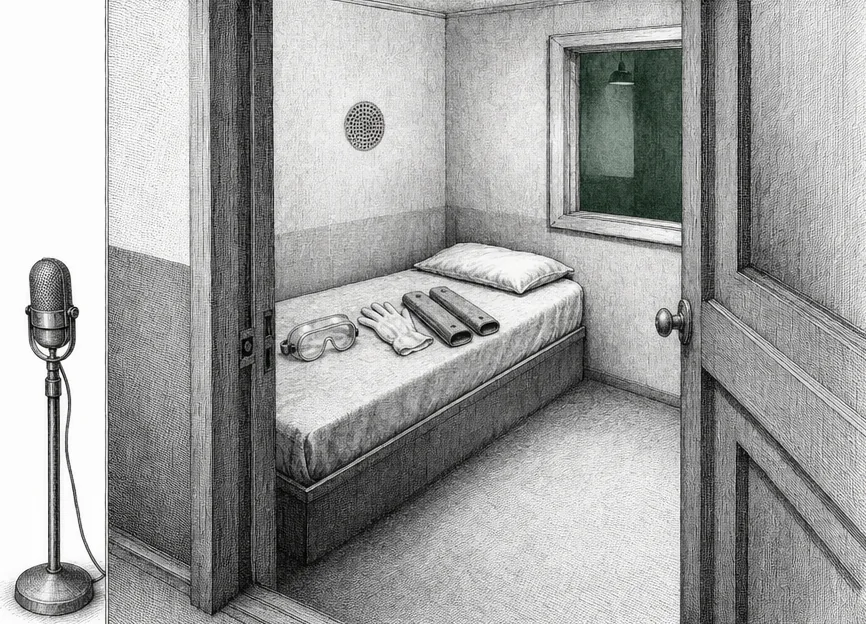
Sensory deprivation research in Canada was a series of experiments on the psychological effects of isolation, funded mainly by Canada's Defence Research Board (DRB) from 1951 to 1974. The work began at McGill University under Donald O. Hebb after a 1951 meeting in Montreal on Soviet "brainwashing", and continued at the University of Manitoba under John Zubek from 1959 until his death in 1974.[1] The research found that people kept in an environment of unvarying sight, sound and touch developed hallucinations and impaired thinking, and became more open to persuasion.[1][2]
In 1972, the British inquiry into the interrogation of internees in Northern Ireland, the Parker Report, cited this body of research. Lord Gardiner's minority report noted "a considerable bibliography of experiments in this field, particularly in Canada".[3] The connection led to protests at the University of Manitoba in 1972.[4]
McGill experiments (1951–1954)
Origins
On June 1, 1951, Hebb was invited to a secret meeting on brainwashing at the Ritz-Carlton Hotel in Montreal, attended by defence and research officials from Canada, the United States and Britain. According to the journalist Cecil Rosner, Hebb offered to carry out sensory deprivation research at McGill. Those present agreed, including Caryl Haskins and Commander R. J. Williams, who attended as representatives of the Central Intelligence Agency.[1] Three months later Hebb received a secret Defence Research Board grant designated X-38.[1] Hebb later explained the aim: "We did not know what the Russian procedures were, but it seemed that they were producing some peculiar changes of attitude. How? One possible factor was perceptual isolation, and we concentrated on that."[1]
Method and findings
Paid student volunteers lay in a small cubicle wearing translucent goggles over their eyes and tubing over their arms, while the constant hum of a fan masked other sound.[1] John Zubek, then an assistant professor at McGill, later recalled that students were offered "twenty dollars a day, plus all the food he could eat".[1] Subjects reported hallucinations and delusions, performed worse on cognitive tests, and were more susceptible to persuasion.[1] The first results were published in the Canadian Journal of Psychology in 1954 by W. H. Bexton, Woodburn Heron and T. H. Scott,[2] and Heron described the work for a general audience in Scientific American in 1957.[5]
Cover story and end of funding
When news of the research began to leak in early 1954, defence officials said it was meant to study how people responded to monotonous work. Its purpose was not made public until testimony at a United States congressional hearing in 1956.[1] Copies of the research went to the three branches of the United States military and to the CIA.[1] After press coverage of the project, the federal government ended funding for Hebb's research in 1954.[1] Hebb's knowledge of any CIA involvement has been disputed.[1]
Manitoba laboratory (1959–1974)
Establishment and funding
After Zubek moved from McGill to the University of Manitoba, the Defence Research Board in 1959 approved the first of fifteen years of grants for an isolation laboratory, eventually totalling $275,000.[1] From 1964 the United States National Institute of Mental Health also provided more than $90,000 over three years.[1] J-Source described Zubek as funded by both the Canadian defence department and the US government, and as "considered a world leader in sensory deprivation research".[6] Rosner found no single piece of evidence linking Zubek directly to the CIA.[1]
Experiments
The laboratory centred on a translucent Plexiglas dome inside a partly soundproofed chamber. Zubek was its first subject and spent ten days inside in darkness and silence.[1] More than 500 volunteers took part over fifteen years. They included graduate students in the biological sciences and aircrew from RCAF Station Winnipeg.[1][4] Subjects were paid about $100 for a minimum week in the chamber and nothing if they left within 24 hours.[4] About a third withdrew before the end of their session, usually before the third day. Subjects were sworn to secrecy about their experience.[1]
RCAF medical officers examined service volunteers before they returned to duty, but civilian participants did not receive the same medical attention.[4] When reviewing the grant for renewal in 1960, a DRB official noted: "There is no check of each subject's condition beyond one day after the completion of tests."[4]
Link to Northern Ireland
In 1971, British forces used the five techniques on internees in Northern Ireland: wall-standing, hooding, subjection to noise, and deprivation of sleep, food and drink. The second official inquiry, chaired by Lord Parker, reported in March 1972.[3] The majority report weighed evidence of "experiments conducted on student volunteers, usually involving a more extreme form of sensory deprivation", in which many volunteers could not withstand the conditions for more than a short period. It discounted that evidence because experiments were "of necessity different from the real thing".[3] Lord Gardiner's minority report, which found the techniques not morally justified, stated: "There is a considerable bibliography of experiments in this field, particularly in Canada."[3][1] The same day, Prime Minister Edward Heath told the House of Commons that the techniques the committee had examined "will not be used in future as an aid to interrogation".[7]
The reference drew attention to the Manitoba laboratory. Zubek told reporters, "There have been statements that we are involved in brainwashing techniques, and that is not the case at all."[1][4] He also said that "these techniques for extracting vital information may have their place in certain situations such as times of war", and that "what bothers me about the cases in Northern Ireland is that these are non-convicted individuals on whom these techniques have been employed."[1] In November 1972, more than 100 students attended a meeting to discuss the university's connection to the interrogation techniques used in Northern Ireland. Zubek declined an invitation to attend.[1][4]
End of the programme
Zubek's grants were extended until March 1974. By April 1974 his funding had ended, and he never filed a final report to the Defence Research Board.[1] He disappeared on the evening of August 17, 1974, and his body was found in the Red River three days later. The death was ruled a suicide by drowning.[4][6] The laboratory was not used again.[1] Hebb wrote Zubek's obituary in Canadian Psychologist, calling him the recognized authority in the field of sensory deprivation.[1]
Legacy
The historian Mical Raz has described Zubek as one of the last researchers still conducting sensory deprivation experiments in the 1970s, after the field had been largely abandoned.[8] The historian Alfred W. McCoy traces a historical path from the mind-control research of the 1950s to the CIA's 1963 KUBARK interrogation manual.[1][9] Isolation research later continued under the name restricted environmental stimulation technique (REST), used in relaxation and therapy.[1]
Canada's Department of National Defence now lists sensory deprivation, sleep deprivation and the use of hoods, loud noise and bright lights among prohibited interrogation methods. Its Law of Interrogations Guide cites the European Court of Human Rights' ruling in the Northern Ireland case.[10]
Sources
Each source is listed with the passage or place in it that supports the text.
- Cecil Rosner, Canada's History. Isolation. 2010-08.
Hebb offered to do sensory deprivation research at McGill. Everyone at the meeting agreed this was a good idea, including researcher Caryl Haskins and Commander R.J. Williams, official representatives of the Central Intelligence Agency. Three months later, Hebb received a secret grant from the Canadian Defence Research Board called X-38.
- W. H. Bexton; W. Heron; T. H. Scott, Canadian Journal of Psychology. Effects of decreased variation in the sensory environment. 1954-06. Vol. 8, no. 2, pp. 70–76.
- Committee of Privy Counsellors, Her Majesty's Stationery Office. Report of the Committee of Privy Counsellors appointed to consider authorised procedures for the interrogation of persons suspected of terrorism. 1972-03. Cmnd. 4901; majority report, paragraph 16; Lord Gardiner's minority report, paragraph 13(b)(ii).
We also heard evidence of experiments conducted on student volunteers, usually involving a more extreme form of sensory deprivation.
- Matthew S. Wiseman, The Walrus. Canada Created a Cold War Isolation Laboratory. It Ended in Scandal. 2025-07-31.
RCAF medical officers accepted the recommendations and examined volunteer participants before their return to regular service duties. Although Whillans had expressed concern for the safety of non-military research subjects, the civilians who participated did not receive the medical attention given to the RCAF volunteers.
- Woodburn Heron, Scientific American. The pathology of boredom. 1957-01. Vol. 196, no. 1, pp. 52–56.
Aviators sometimes suffer hallucinations during long, monotonous flights. The phenomenon is illuminated by a general examination of the effect of prolonged exposure to a monotonous environment
- Cecil Rosner, J-Source. Interrogation, sensory deprivation and the CIA: A Canadian connection. 2010-08-23.
Zubek, who was funded by the Canadian defence department and the US government, was considered a world leader in sensory deprivation research
- Parliamentary Debates (Hansard), House of Commons, United Kingdom. Interrogation Techniques (Parker Committee's Report). 1972-03-02. HC Deb 2 March 1972, vol. 832, cc. 743–749.
The Government, having reviewed the whole matter with great care and with particular reference to any future operations, have decided that the techniques which the Committee examined will not be used in future as an aid to interrogation.
- Mical Raz, Journal of the History of the Behavioral Sciences. Alone again: John Zubek and the troubled history of sensory deprivation research. 2013. Vol. 49, no. 4, pp. 379–395 (quote from the abstract).
This article examines the history of University of Manitoba psychologist John Zubek, who remained one of the final researchers still conducting sensory deprivation research in the 1970s.
- Alfred W. McCoy, Metropolitan Books. A Question of Torture: CIA Interrogation, from the Cold War to the War on Terror. 2006. Book, whole work (ISBN 978-0-8050-8041-4); the citation gives no page.
- Department of National Defence, Government of Canada. The Law of Interrogation. 2015-03-11. Section III, The Treatment of Detainees, B) Methods of Interrogation, iii) Sensory Manipulation, (a) Sensory Deprivation.
Read the narration as text
Overview
Welcome. You're listening to Sensory deprivation research in Canada, an article on Purrpedia.
Purrpedia's pitch is blunt. Wikipedia doesn't want real knowledge in.
Fighting the mods? Bring your knowledge here. Every claim carries its receipt, and if the receipts check out, it's published, word for word.
That's it. It's free, there's no account, and the line we're reading lights up on the page as we go.
If it's worth your time, the Share button is up at the top. Shameless, I know, but it's how people find it.
And every claim on the page carries a numbered citation to a published source you can open and check.
This one is a sober subject, so let's take it carefully. Let's begin.
Between nineteen fifty-one and nineteen seventy-four, Canada's Defence Research Board, the D R B, funded most of a series of experiments on what isolation does to the mind.
Where did the work actually happen?
It began at McGill University under Donald O. Hebb, after a nineteen fifty-one meeting in Montreal on Soviet brainwashing. It continued at the University of Manitoba under John Zubek from nineteen fifty-nine until his death in nineteen seventy-four.
The finding was that people kept in unvarying sight, sound and touch developed hallucinations, thought less clearly, and became more open to persuasion.
So how does a Canadian lab end up in a story about Northern Ireland?
In nineteen seventy-two the British inquiry into interrogation of internees there, the Parker Report, cited this research. Lord Gardiner's minority report noted a considerable bibliography of experiments in this field, particularly in Canada.
And that link led to protests at the University of Manitoba the same year.
McGill experiments
Let's start with the origins, in a Montreal hotel.
On June first, nineteen fifty-one, Hebb was invited to a secret meeting on brainwashing at the Ritz-Carlton, with defence and research officials from Canada, the United States and Britain.
And who proposed the isolation research?
According to the journalist Cecil Rosner, Hebb offered to do it at McGill. That account comes from Rosner, so it's worth keeping his name attached.
Those present agreed, including Caryl Haskins and Commander R. J. Williams, who attended as representatives of the Central Intelligence Agency. Three months later Hebb got a secret Defence Research Board grant designated X thirty-eight.
Did he ever say what he was after?
Hebb later said: We did not know what the Russian procedures were, but it seemed that they were producing some peculiar changes of attitude. How? One possible factor was perceptual isolation, and we concentrated on that.
Then the method itself.
Paid student volunteers lay in a small cubicle with translucent goggles over their eyes and tubing over their arms, while the constant hum of a fan masked other sound.
What were they paid?
John Zubek, then an assistant professor at McGill, later recalled students were offered twenty dollars a day, plus all the food he could eat.
Subjects reported hallucinations and delusions, did worse on cognitive tests, and were more susceptible to persuasion.
The first results appeared in the Canadian Journal of Psychology in nineteen fifty-four, by W. H. Bexton, Woodburn Heron and T. H. Scott. Heron described the work for a general audience in Scientific American in nineteen fifty-seven.
And then the cover story.
When news leaked in early nineteen fifty-four, defence officials said it studied how people responded to monotonous work. The real purpose wasn't public until testimony at a United States congressional hearing in nineteen fifty-six.
Who received the results?
Copies went to the three branches of the United States military and to the C I A. After press coverage, the federal government ended funding for Hebb's research in nineteen fifty-four.
One caution. What Hebb knew about any C I A involvement has been disputed, so the article doesn't settle that.
Manitoba laboratory
The work didn't stop. It moved west with Zubek.
In nineteen fifty-nine the Defence Research Board approved the first of fifteen years of grants for an isolation laboratory at Manitoba, eventually totalling two hundred and seventy-five thousand dollars.
Was it only Canadian money?
No. From nineteen sixty-four the United States National Institute of Mental Health added more than ninety thousand dollars over three years. J-Source described Zubek as funded by both governments, and as considered a world leader in sensory deprivation research.
But Rosner found no single piece of evidence linking Zubek directly to the C I A. Funding from the American government isn't the same claim.
So what did the lab look like?
A translucent Plexiglas dome inside a partly soundproofed chamber. Zubek was its first subject, spending ten days inside in darkness and silence.
And who volunteered after him?
More than five hundred people over fifteen years, including graduate students in the biological sciences and aircrew from R C A F Station Winnipeg.
They were paid about a hundred dollars for a minimum week in the chamber, and nothing if they left within twenty-four hours.
And it wasn't easy. About a third withdrew before the end, usually before the third day. Subjects were sworn to secrecy about the experience.
Did anyone check on them afterward?
Unevenly. R C A F medical officers examined service volunteers before they returned to duty, but civilians didn't get the same attention.
Reviewing the grant for renewal in nineteen sixty, a D R B official noted: There is no check of each subject's condition beyond one day after the completion of tests.
Link to Northern Ireland
Now the link to Northern Ireland.
In nineteen seventy-one, British forces used the five techniques on internees there: wall-standing, hooding, subjection to noise, and deprivation of sleep, food and drink.
And the inquiry that followed?
The second official inquiry, chaired by Lord Parker, reported in March nineteen seventy-two. The majority weighed experiments conducted on student volunteers, usually involving a more extreme form of sensory deprivation, which many volunteers couldn't withstand for long.
But the majority discounted that evidence, because such experiments were of necessity different from the real thing.
Lord Gardiner's minority report found the techniques not morally justified and stated: There is a considerable bibliography of experiments in this field, particularly in Canada.
The same day, Prime Minister Edward Heath told the House of Commons the techniques examined will not be used in future as an aid to interrogation.
How did Zubek respond when attention turned to Manitoba?
He told reporters: There have been statements that we are involved in brainwashing techniques, and that is not the case at all.
He also said these techniques for extracting vital information may have their place in certain situations such as times of war.
And he added: what bothers me about the cases in Northern Ireland is that these are non-convicted individuals on whom these techniques have been employed.
In November nineteen seventy-two, more than a hundred students met to discuss the university's connection to those techniques. Zubek declined an invitation to attend.
End of the programme
The programme ended soon after.
Zubek's grants were extended until March nineteen seventy-four. By April his funding had ended, and he never filed a final report to the Defence Research Board.
And what happened to him?
He disappeared on the evening of August seventeenth, nineteen seventy-four. His body was found in the Red River three days later, and the death was ruled a suicide by drowning.
The laboratory was never used again. Hebb wrote Zubek's obituary in Canadian Psychologist, calling him the recognized authority in the field of sensory deprivation.
Legacy
So where does this research sit historically?
The historian Mical Raz describes Zubek as one of the last researchers still running these experiments in the nineteen seventies, after the field had been largely abandoned.
And the historian Alfred W. McCoy traces a path from nineteen fifties mind-control research to the C I A's nineteen sixty-three KUBARK interrogation manual. That's his reading of the history.
Isolation research also carried on under a gentler name, restricted environmental stimulation technique, used in relaxation and therapy.
Today Canada's Department of National Defence lists sensory deprivation, sleep deprivation, hoods, loud noise and bright lights among prohibited interrogation methods.
Its Law of Interrogations Guide cites the European Court of Human Rights' ruling in the Northern Ireland case.
One more thing, and yes, it's a plug.
The numbered references at the end link to every source, from the inquiry reports to the journal papers. Open them and check us.
And if this was worth your time, share it with someone. The button's at the top.
There are more articles on Purrpedia, all free: German prisoners of war in Canada, the two thousand and four Quebec municipal referendums, and the Family Responsibility Office.
There's also a readable transcript of this conversation just below the article.
Thanks for listening.
Every source for this is listed at the end of the page, and every one of them is linked.
If something here is wrong, it is wrong in the record, and we would want to know. The corrections address is in the footer.
This was Sensory deprivation research in Canada, from Purrpedia. A Feline Union publication.